Last chance to get up to $100 of BTC and Trade Different with Ledger Wallet™

Bitcoin bonus

Bitcoin wallet

Find the right crypto wallet for your Bitcoin

To truly own your Bitcoin, you need a secure place to manage your private keys, the critical codes that grant you access to your funds. Ledger offers one of the safest Bitcoin wallet solutions, designed to keep those keys offline and resistant to hacking attempts.

Join over 8 million happy customers who trust Ledger to safeguard their BTC. By pairing our hardware wallet with the Ledger Wallet app (for mobile & desktop), you get the ultimate security of cold storage with the ease of managing your Bitcoin day-to-day.

  • Mobile & Desktop App
  • Made safe with Secure Element chip

Trusted by over 8 million customers

Bitcoin  wallet
Ledger Secured Solution

How can you secure your Bitcoin (BTC)?

To truly secure your Bitcoin, you must protect your private keys from online threats. Unlike software wallets that keep keys connected to the internet, a hardware wallet stores your keys offline, making them resistant to remote hacks and malware.


Ledger signers provide an extra layer of protection with a certified Secure Element chip, the same technology used in passports, to isolate your sensitive data. When you pair your device with the Ledger WalletTM app, you combine the security of cold storage with the convenience of managing your assets daily.

A hardware device

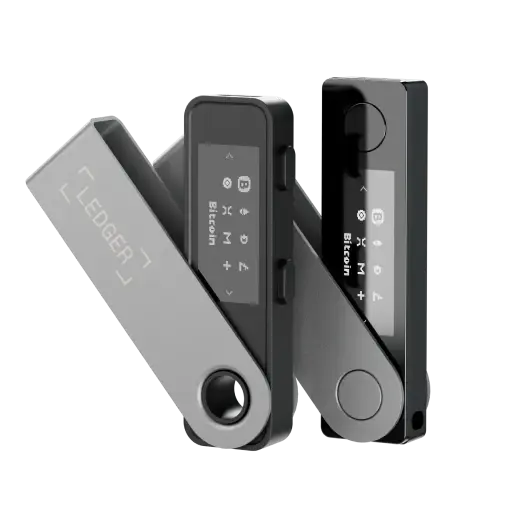
Your keys are stored offline on a hardware wallet that is protected by a certified Secure Element chip. This cold storage ensures your Bitcoin is isolated from hackers and online threats, leaving you in sole control. Use it with the Ledger Wallet app for optimal freedom and control of your BTC.

Ledger Wallet™ App

Turn your mobile device into a secure Web3 gateway. The Ledger Wallet app offers the convenience of the best mobile wallets while letting you manage Bitcoin and thousands of other major cryptocurrencies safely. Manage all your crypto wallets with clarity and confidence.

How to get a Bitcoin wallet?

1
Get a Ledger signer

Get a Ledger signer

Choose the signer that best fits your lifestyle. All Ledger hardware devices protect your private keys with the industry-leading Secure Element chip and Ledger OS™.

Ledger touchscreen signers give you extra control with Clear Signing, Transaction Check and a large display. The classic Ledger swivel signers give you the core security features you need to get started with self-custody.

Choose your hardware device

2
Download the Ledger Wallet™ app

Download the Ledger Wallet™ app

Install the Ledger Wallet app to unlock a unified view of your portfolio. It offers the ease of use found in top mobile wallets but connects to your hardware, allowing you to securely manage your favorite cryptos across multiple chains in real time.

3
Start your Bitcoin journey securely

Start your Bitcoin journey securely

Open the app and add a Bitcoin (BTC) account. It is simple to send and receive crypto or secure large amounts for the long term, making the full potential of Web3 accessible without compromising on security.

The best way to keep your Bitcoin secure

Compare our wallets

Manage, buy and swap Bitcoin seamlessly

Manage your Bitcoin (BTC)

Manage your Bitcoin (BTC)

With the Ledger Wallet app paired to your device, you can:

  • Securely send and receive funds. Your private keys remain encrypted within the secure chip, requiring physical validation on the device for every transfer, ensuring no funds leave without your manual approval.
  • Store Bitcoin and manage thousands of other tokens across multiple blockchains in one place.
  • Track your portfolio performance and real-time balance.

*Buy, send/receive, swap, stake, and other crypto transaction services are provided by third-parties providers, whose availability may vary based on jurisdiction/territory.

Buy Bitcoin

Buy Bitcoin

Through our ecosystem of trusted partners, users can purchase Bitcoin (BTC) using a credit card or bank transfer. The crypto is sent directly to your personal wallet address, removing the need to transfer them later and saving you from paying extra network fees.

Because your private keys are encrypted and stored offline on your hardware device, your wealth remains protected from online threats and exchange vulnerabilities. It is one of the safest ways to buy Bitcoin and quickly secure it.

Buy Bitcoin

What is a Bitcoin wallet?

A Bitcoin wallet is a tool, typically software or a hardware device, that safeguards the credentials needed to access your funds. Contrary to what the name suggests, a wallet does not store the actual cryptocurrency; your Bitcoin exists on the blockchain network. Instead, the wallet holds your private keys, the unique digital codes that prove your ownership and allow you to authorize transactions.

How does a Bitcoin wallet work?

Bitcoin wallets function using a cryptographic system that relies on a pair of keys:

  • Public Key: Acts like an email address or bank account number. It generates the address you share with others to receive funds.
  • Private Key: Acts like a password or PIN. It is a secret string of characters that grants total control over the funds.

To send Bitcoin, your wallet uses the private key to ‘sign’ the transaction. Because anyone with this key can access your assets, it must remain strictly confidential and secure.

What are the different types of Bitcoin wallets?

To choose the best bitcoin wallet for your needs, it is critical to understand where your private keys are held and whether they are exposed to the internet.

  • Centralized exchange solutions: Platforms such as Coinbase or Binance provide a convenient way to purchase digital currency. However, these are custodial services, meaning they hold the private keys for you. If the platform halts withdrawals or goes bankrupt, your assets could be lost. For true ownership, moving funds to a non-custodial wallet is essential.
  • Software-based options: Also known as “hot storage,” these programs run on internet-connected devices. They give you control over your keys but remain vulnerable to malware and hacks.
    • Mobile wallets: These smartphone apps are convenient for face-to-face payments and QR code scanning. However, because mobile phones are always online and frequently lost or damaged, they carry significant security risks.
    • Desktop wallets: Installing dedicated software on your computer offers robust features for managing portfolios. Yet, if your computer is compromised by a virus or keylogger, your private keys could be stolen.
  • Browser extensions: Tools that plug into your web browser to access Web3 apps. While convenient, they are frequent targets for phishing attacks and should not be used to store significant value.
  • Paper & brain wallets: Methods like paper wallets (printing keys on paper) or a brain wallet (memorizing a seed phrase) are now considered obsolete. Neither is a recommendable, reliable, or durable option: paper degrades, burns, or gets lost, while human memory is fallible.
  • Hardware solutions: The industry standard for security. Devices like Ledger function as cold wallets, storing your private keys offline on a certified Secure Element chip. Protected by a PIN code and a 24-word recovery phrase, they isolate your assets from online threats while allowing you to safely manage them via the Ledger Wallet app.

Are These Solutions Free?

Costs vary significantly by method. Mobile wallets and desktop wallets are typically free to download, but this ‘free’ access often comes with hidden costs: the high risk of theft via malware, hacks, or centralization.

In contrast, hardware devices require an upfront investment. However, this one-time cost provides superior security by keeping your keys offline, serving as an essential guardrail against the potential loss of your entire portfolio.

How to choose the best option?

Your ideal choice depends on your specific needs, risk tolerance, and how you intend to use your crypto:

  • Long-term protection: For securing significant holdings, a hardware solution (cold storage) is the preferred choice for long-term security. Obsolete methods like paper wallets or a brain wallet are too unreliable for modern security needs.
  • Everyday transactions: For managing smaller amounts or frequent spending, a mobile wallet or software application may be sufficient due to its convenience.
  • Advanced features: Considerations such as support for the Lightning Network (for faster, cheaper payments) or multi-user management may also influence your decision.

Ultimately, the best bitcoin wallet is one that aligns with your usage while giving you full control over your digital assets.

Chosen by 8,000,000+ customers

“Ledger = peace of mind. I'm sure some of us know that unsettling feeling when you know you need a Ledger but haven't quite organized yourself to get it sorted. If I did it all again, I'd start with having a Ledger.”

Janet Onagah @Janet_Oganah

"I got hacked in January and lost 1000s worth of NFTs. I felt disgusted, lost, and willing to quit. Until my friend told me he's ordering a Ledger. So, we bought the duo deal. Since then, I've been sleeping."

PrimeNic.eth @primenic_eth

“I use multiple Ledgers. Different colours = different uses.Public Wallet. Never touch long term storage. Day to day fund holdings. A back up just in case.”

winny.eth @winnyeth

"I have 3 Ledgers. Hot Wallet: minting/drawings etc. Main wallet: store most NFTs. Vault wallet: cold storage of crypto."

2160 @rekt2160

“I have 5 Ledger total. My personal NFT bag. 1 for testing. And 1 for each of my 3 daughters.”

Fanzo 🧢 11.11.22 @iSocialFanz

"If I could, I would name my Ledger Hagrid. Cause it's the keeper of my keys."

Petrica Butusina @PetricaButusina

"My Ledger is already called "Stew". As it is the steward who looks after my crypto & NFTs, so I can sleep at night."

Lkmland Crypto 💫 @LkmlandCrypto

"Ledger makes cold storage downright easy. My NFTs land infinitely safer and I don’t have to feel as paranoid about connecting to new smart contracts."

Matt Oney @MattOney93

Cryptocurrencies similar to Bitcoin supported by Ledger crypto wallets

Bitcoin, Ethereum, USDT, Solana and more…

FAQ

Find answers to some of the most common questions.

Bitcoin is the first successful form of digital money based on peer-to-peer technology that facilitates decentralized transactions whereby. No central bank or centralized authority is involved in the transaction and production of the Bitcoin currency. The Bitcoin network records transactions on a distributed ledger (blockchain) comprising multiple nodes (computers) globally. 

Bitcoin was created by an anonymous individual/group under the name, Satoshi Nakamoto. Satoshi Nakamoto, a pseudonymous cypherpunk, published the Bitcoin white paper on October 31, 2008. The source code is available publicly as an open-source project, anybody can look at it and be part of the developmental process.

Following are some of Bitcoin’s important characteristics:

  • Scarce: Bitcoin is designed to have a finite supply of 21 million BTC ever created, thus making it an anti-inflationary financial asset.
  • Fungible: Bitcoin is a fungible asset such that every coin is identical and equivalent to another.
  • Divisible: Bitcoin’s divisibility follows from its fungibility. 1 BTC is thus divisible into satoshis (sats), up to eight decimal places (1 BTC = 100 million sats).

Regarding Bitcoin mining, miners today are mining Bitcoin using ASIC chips dedicated to mining Bitcoin. Bitcoin uses the SHA-256 hashing algorithm with an average transaction confirmation time of 10 minutes.

Bitcoin has inspired other alternative currencies such as Litecoin, Peercoin, Primecoin, and so on.

When you first buy coins, you’re issued with two keys: public and private.

A private key represents a randomly generated number that signs transactions and protects your assets from malicious attacks. If it gets compromised or lost, you won’t be able to access your cold wallet to spend, withdraw, or transfer your coins.

To safeguard and keep track of your keys, you can use online or offline wallets. Online wallets, also known as hot wallets, store private keys on systems or devices that are connected to the internet. Hot wallets are easy and convenient to use, however, they come with several drawbacks. Besides being susceptible to attacks and a honeypot for hackers, with hot wallets, the custody of private keys is often entrusted to a third party such as a crypto exchange, which means you never have full control over your funds. 

The safer choice is specialized hardware wallets that store private keys offline. Stealing private keys from a hardware wallet would require physical access to the wallet and the corresponding PIN or the recovery phrase. What’s more, with a hardware wallet, you don’t need to rely on third-party custodians.

Ledger signers have been built using highly durable materials for protection against physical damage.

Initially, the primary step is to create a crypto wallet if you haven’t done it yet. Once you have completed this step, the process of executing a Bitcoin transfer is quite similar to almost every crypto wallet.

  1. Enter the recipient address of the Bitcoin wallet you want to send BTC.
  2. Enter the amount or quantity of Bitcoin you wish to send.
  3. Choose the Network fees.
  4. Verify the transaction summary before sending it.

However, it is crucial to follow our advice before sending Bitcoin to another wallet:

  • For optimal security, make sure always to double-check the addresses that you copy and paste. When possible, using a QR code address might be the preferable method, just to be absolutely certain.
  • For larger transactions, it may be a good idea to send a small amount of Bitcoin as a test, to make sure the address is correct.
  • For a wallet that supports multiple cryptocurrencies, it’s also important to select the correct coin. Sending Bitcoin (BTC) to a Bitcoin Cash (BCH) address, for example, could result in a permanent loss of funds.
  • For sending Bitcoin quickly, higher-fee transactions are usually given higher priority by Bitcoin miners and will reach their destination in a shorter amount of time.

Each crypto-related endeavor necessitates a wallet. If you wish to receive Bitcoin from another party, you must furnish them with a Bitcoin wallet address. However, to obtain a Bitcoin wallet address, you first need to acquire a cryptocurrency wallet compatible with BTC and create a new account. 

Subsequently, you can locate your receiving address within your wallet’s interface. It’s crucial to accurately record this address, as any error could result in funds being sent to a wallet beyond your control.

To send or receive BTC, you’ll require a Bitcoin wallet address, a unique string of 26-35 characters starting with ‘1′, ‘3′, or ‘bc1′. Each address corresponds to a key pair: a public key for identification and a private key for transaction signing. Your wallet address is essentially a user-friendly version of your public key.

For privacy protection, Bitcoin wallets generate new addresses for each transaction, though old ones remain functional. This practice safeguards your wallet’s security, particularly if you use an online wallet vulnerable to key exposure during transaction signing. Hence, most wallets automatically generate new addresses per transaction to mitigate risks.

No, at the moment, the Ledger Bitcoin wallet does not support Lightning Network.

Bitcoin is the first successful form of digital money based on peer-to-peer technology that facilitates decentralized transactions whereby. No central bank or centralized authority is involved in the transaction and production of the Bitcoin currency. The Bitcoin network records transactions on a distributed ledger (blockchain) comprising multiple nodes (computers) globally. 

Bitcoin was created by an anonymous individual/group under the name, Satoshi Nakamoto. Satoshi Nakamoto, a pseudonymous cypherpunk, published the Bitcoin white paper on October 31, 2008. The source code is available publicly as an open-source project, anybody can look at it and be part of the developmental process.

Following are some of Bitcoin’s important characteristics:

  • Scarce: Bitcoin is designed to have a finite supply of 21 million BTC ever created, thus making it an anti-inflationary financial asset.
  • Fungible: Bitcoin is a fungible asset such that every coin is identical and equivalent to another.
  • Divisible: Bitcoin’s divisibility follows from its fungibility. 1 BTC is thus divisible into satoshis (sats), up to eight decimal places (1 BTC = 100 million sats).

Regarding Bitcoin mining, miners today are mining Bitcoin using ASIC chips dedicated to mining Bitcoin. Bitcoin uses the SHA-256 hashing algorithm with an average transaction confirmation time of 10 minutes.

Bitcoin has inspired other alternative currencies such as Litecoin, Peercoin, Primecoin, and so on.

When you first buy coins, you’re issued with two keys: public and private.

A private key represents a randomly generated number that signs transactions and protects your assets from malicious attacks. If it gets compromised or lost, you won’t be able to access your cold wallet to spend, withdraw, or transfer your coins.

To safeguard and keep track of your keys, you can use online or offline wallets. Online wallets, also known as hot wallets, store private keys on systems or devices that are connected to the internet. Hot wallets are easy and convenient to use, however, they come with several drawbacks. Besides being susceptible to attacks and a honeypot for hackers, with hot wallets, the custody of private keys is often entrusted to a third party such as a crypto exchange, which means you never have full control over your funds. 

The safer choice is specialized hardware wallets that store private keys offline. Stealing private keys from a hardware wallet would require physical access to the wallet and the corresponding PIN or the recovery phrase. What’s more, with a hardware wallet, you don’t need to rely on third-party custodians.

Ledger signers have been built using highly durable materials for protection against physical damage.

Initially, the primary step is to create a crypto wallet if you haven’t done it yet. Once you have completed this step, the process of executing a Bitcoin transfer is quite similar to almost every crypto wallet.

  1. Enter the recipient address of the Bitcoin wallet you want to send BTC.
  2. Enter the amount or quantity of Bitcoin you wish to send.
  3. Choose the Network fees.
  4. Verify the transaction summary before sending it.

However, it is crucial to follow our advice before sending Bitcoin to another wallet:

  • For optimal security, make sure always to double-check the addresses that you copy and paste. When possible, using a QR code address might be the preferable method, just to be absolutely certain.
  • For larger transactions, it may be a good idea to send a small amount of Bitcoin as a test, to make sure the address is correct.
  • For a wallet that supports multiple cryptocurrencies, it’s also important to select the correct coin. Sending Bitcoin (BTC) to a Bitcoin Cash (BCH) address, for example, could result in a permanent loss of funds.
  • For sending Bitcoin quickly, higher-fee transactions are usually given higher priority by Bitcoin miners and will reach their destination in a shorter amount of time.

Each crypto-related endeavor necessitates a wallet. If you wish to receive Bitcoin from another party, you must furnish them with a Bitcoin wallet address. However, to obtain a Bitcoin wallet address, you first need to acquire a cryptocurrency wallet compatible with BTC and create a new account. 

Subsequently, you can locate your receiving address within your wallet’s interface. It’s crucial to accurately record this address, as any error could result in funds being sent to a wallet beyond your control.

To send or receive BTC, you’ll require a Bitcoin wallet address, a unique string of 26-35 characters starting with ‘1′, ‘3′, or ‘bc1′. Each address corresponds to a key pair: a public key for identification and a private key for transaction signing. Your wallet address is essentially a user-friendly version of your public key.

For privacy protection, Bitcoin wallets generate new addresses for each transaction, though old ones remain functional. This practice safeguards your wallet’s security, particularly if you use an online wallet vulnerable to key exposure during transaction signing. Hence, most wallets automatically generate new addresses per transaction to mitigate risks.

No, at the moment, the Ledger Bitcoin wallet does not support Lightning Network.

Related Resources

Stay in touch

Announcements can be found in our blog. Press contact:
[email protected]

Subscribe to our
newsletter

New coins supported, blog updates and exclusive offers directly in your inbox


Your email address will only be used to send you our newsletter, as well as updates and offers. You can unsubscribe at any time using the link included in the newsletter. Learn more about how we manage your data and your rights.