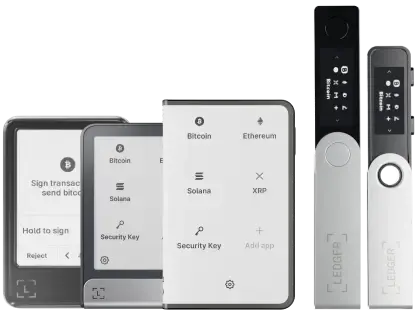
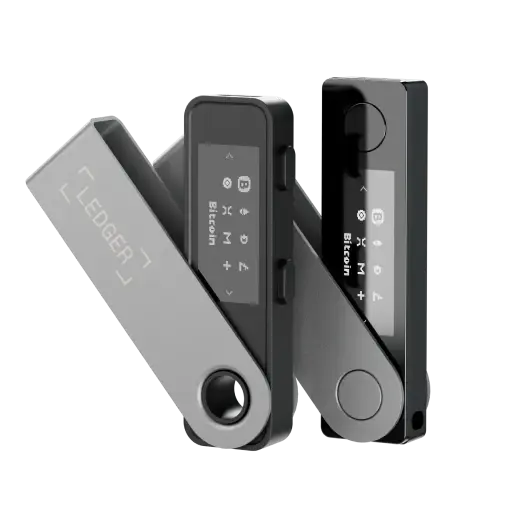
Meet Ledger Nano™ Gen5, the most playful signer yet

Discover now

Tezos wallet

Discover the right crypto wallet for your Tezos

Looking for a Tezos wallet to buy, sell, swap, or grow your Tezos? Join 8+ million happy customers who use Ledger to manage their crypto holdings every day.

  • Mobile & Desktop App
  • Secured by Hardware Wallet

Trusted by over 8 million customers

Tezos wallet
Ledger Secured Solution

How to secure your Tezos

Whether you’re looking to keep your crypto safe for long-term or manage them on a daily basis, Ledger has the right product for you.

Ledger hardware wallet

Protects your crypto wallets, keeping your private keys offline, far from hackers’ reach and resistant to online threats. Use it with the Ledger Wallet™ app for optimal freedom and control of your Tezos.

Ledger Wallet™ App

Do more with your Tezos, get timely insights, make informed choices, stake your assets… all in one place. Manage all your crypto wallets with clarity and confidence.

Quick, easy steps to get a Tezos wallet

1
Buy a Ledger hardware wallet

Buy a Ledger hardware wallet

Choose the certified secure Ledger signer that best fits your lifestyle. All Ledger devices protect your private keys with the industry-leading Secure Element chip and constantly updated Ledger OS™.

Ledger touchscreen signers give you extra control with Clear Signing, Transaction Check, and a large display for greater everyday ease. Classic Ledger swivel signers give you the battle-tested security features you need to get started with self-custody.

Choose your hardware device

2
Download the Ledger Wallet™ app

Download the Ledger Wallet™ app

Enjoy the convenience of a desktop wallet or a mobile wallet, with the security of a hardware wallet. Use this all in one app to compare service providers and monitor prices across multiple chains. Buy crypto, swap, stake, and more.

Make informed decisions at just the right time to manage your Tezos with ease and extra peace of mind.

3
Start your Tezos journey securely

Start your Tezos journey securely

Set up a Tezos wallet account in a few seconds and manage it seamlessly via the Ledger Wallet™ app.

The best way to keep your Tezos secure

Compare our wallets

You can Buy, Manage, and Stake Tezos, now ready to use

Manage your Tezos

Manage your Tezos

Ledger Wallet™ enables you to buy/sell, send/receive, swap and stake your crypto, all in one place, powered by popular third-party service providers.

Buy Tezos

Buy Tezos

You can buy Tezos with a credit/debit card or bank transfer. Choose from a range of service providers like MoonPay, Coinbase, and Revolut.

Your Tezos will land safely in your Ledger Tezos Wallet.

Buy Tezos

Stake Tezos

Stake Tezos

Put your Tezos to work and earn rewards.

Start staking in just a few clicks via the Ledger Wallet™ app. Track rewards in the Earn section. Explore opportunities across chains.

Rewards are not guaranteed. Ledger does not provide any financial advice or recommendation.

Stake Tezos

What is Tezos?

Tezos is a blockchain platform created by a former Morgan Stanley analyst, Arthur Breitman. It is a smart contract platform that does not involve mining. Tezos promotes self-amendment and on-chain governance, and is similar to Ethereum. The community can vote to improve the platform, and token holders can delegate their voting rights to others. The platform uses a generic network shell that allows for different transaction and consensus protocols. The code is written in OCaml, a fast and functional programming language. Tezos uses a proof-of-stake consensus algorithm called “liquid proof-of-stake,” which aims to balance security and decentralization. The process of staking in Tezos is called “baking.” Bakers who make deposits will be rewarded for signing and publishing blocks, but may forfeit their deposits if they engage in bad behavior. The annualized yield for stakers is approximately 5.8% as of May 2021. The Tezos foundation raised $232 million in an initial coin offering in 2017, and the mainnet was successfully launched in 2018 after a delay due to corporate governance disputes. The founders have warned that the network is using new technology, so unexpected issues may still occur.

Chosen by 8,000,000+ customers

“Ledger = peace of mind. I'm sure some of us know that unsettling feeling when you know you need a Ledger but haven't quite organized yourself to get it sorted. If I did it all again, I'd start with having a Ledger.”

Janet Onagah @Janet_Oganah

"I got hacked in January and lost 1000s worth of NFTs. I felt disgusted, lost, and willing to quit. Until my friend told me he's ordering a Ledger. So, we bought the duo deal. Since then, I've been sleeping."

PrimeNic.eth @primenic_eth

“I use multiple Ledgers. Different colours = different uses.Public Wallet. Never touch long term storage. Day to day fund holdings. A back up just in case.”

winny.eth @winnyeth

"I have 3 Ledgers. Hot Wallet: minting/drawings etc. Main wallet: store most NFTs. Vault wallet: cold storage of crypto."

2160 @rekt2160

“I have 5 Ledger total. My personal NFT bag. 1 for testing. And 1 for each of my 3 daughters.”

Fanzo 🧢 11.11.22 @iSocialFanz

"If I could, I would name my Ledger Hagrid. Cause it's the keeper of my keys."

Petrica Butusina @PetricaButusina

"My Ledger is already called "Stew". As it is the steward who looks after my crypto & NFTs, so I can sleep at night."

Lkmland Crypto 💫 @LkmlandCrypto

"Ledger makes cold storage downright easy. My NFTs land infinitely safer and I don’t have to feel as paranoid about connecting to new smart contracts."

Matt Oney @MattOney93

Cryptocurrencies similar to Tezos supported by Ledger crypto wallets

Bitcoin, Ethereum, USDT, Solana and more…

FAQ

Find answers to some of the most common questions.

Tezos occupies a unique place among cryptocurrency networks primarily drawing from its on-chain governance model and PoS consensus. In particular, Tezos is part of a new generation of PoS blockchain networks seeking to improve upon Bitcoin’s proof-of-work (PoW) with faster finality consensus, a more scalable design from launch, and less energy expenditure.

Tezos is a smarts contracts platform like Ethereum, but is based on the programming language Michelson and deploys some slight optimizations to the smart contract archetype of Ethereum — such as with formal verification for enhanced contract security. Officially live since September 2018, Tezos has been gathering community support and development contributions in large part due to its offerings of bug bounties, staking incentives, and partnerships designed to bring more community members into the fold.

Compared to other blockchain networks, Tezos distinguishes itself from other networks in mainly two ways:

  1. Staking Mechanism (Called ‘Baking’)
  2. On-Chain Community Governance

Baking is the process of staking funds in the Tezos network to validate blocks and receive the corresponding block reward. Additionally, bakers (i.e., stakers) play a prominent role in the network’s governance with voting power correlating to their overall stake of the native Tezos token, XTZ, locked in the network.

Token holders are not forced to stake their XTZ, however. Token holders can voluntarily participate in staking by delegating them to other bakers to stake on their behalf.

Similarly, XTZ holders can also delegate their tokens for the process of voting in governance proposals. The on-chain governance structure of Tezos is such that voting on proposals is related to the size of a user’s network holdings in XTZ. Proposals can be issued by developers and other network participants with invoices attached to them for funding of development.

The initial voting system is pre-defined, but what is unique about Tezos is that the voting mechanism can actually be changed by governance proposals, just like many other aspects of the network. Stakeholder votes can trigger protocol changes, and even core tenets of the network can be altered, albeit with much more difficulty. The concept is to foster a community environment that is capable of rapidly evolving the network to meet dynamic requirements.

When you first buy crypto, you’re issued with two keys: public and private.

  • A public key serves as an address that can be shared with other parties to perform transactions.
  • A private key represents a randomly generated number that signs transactions and protects your assets from malicious attacks. If it gets compromised or lost, you won’t be able to access your hardware wallet to spend, withdraw, or transfer your coins.

To safeguard and keep track of your keys, you can use online or offline wallets. Online wallets, also known as hot wallets, store private keys on systems or devices that are connected to the internet. Hot wallets are easy and convenient to use, however, they come with several drawbacks. Besides being susceptible to attacks and a honeypot for hackers, with hot wallets, the custody of private keys is often entrusted to a third party such as a crypto exchange, which means you never have full control over your funds. The safer choice are specialized hardware wallets that store private keys offline. Stealing private keys from a hardware wallet would require physical access to the wallet and corresponding PIN or the recovery phrase. What’s more, with hardware wallet, you don’t need to rely on third party custodians.

Ledger Nano is the industry-leading hardware wallet. With more than five million customers, Ledger Nano wallets have several layers of security that protect private keys, and hence your assets:

  • Your private keys are stored on secure element chips.
  • A PIN code and a 24-word recovery phrase are required to access the wallet.
  • Ledger Nano wallets have been built using highly durable materials for protection against physical damage.

With full isolation between private keys and your computer/mobile, Ledger Nano cold wallets keep your keys secure and give you complete control over your coins.

Tezos occupies a unique place among cryptocurrency networks primarily drawing from its on-chain governance model and PoS consensus. In particular, Tezos is part of a new generation of PoS blockchain networks seeking to improve upon Bitcoin’s proof-of-work (PoW) with faster finality consensus, a more scalable design from launch, and less energy expenditure.

Tezos is a smarts contracts platform like Ethereum, but is based on the programming language Michelson and deploys some slight optimizations to the smart contract archetype of Ethereum — such as with formal verification for enhanced contract security. Officially live since September 2018, Tezos has been gathering community support and development contributions in large part due to its offerings of bug bounties, staking incentives, and partnerships designed to bring more community members into the fold.

Compared to other blockchain networks, Tezos distinguishes itself from other networks in mainly two ways:

  1. Staking Mechanism (Called ‘Baking’)
  2. On-Chain Community Governance

Baking is the process of staking funds in the Tezos network to validate blocks and receive the corresponding block reward. Additionally, bakers (i.e., stakers) play a prominent role in the network’s governance with voting power correlating to their overall stake of the native Tezos token, XTZ, locked in the network.

Token holders are not forced to stake their XTZ, however. Token holders can voluntarily participate in staking by delegating them to other bakers to stake on their behalf.

Similarly, XTZ holders can also delegate their tokens for the process of voting in governance proposals. The on-chain governance structure of Tezos is such that voting on proposals is related to the size of a user’s network holdings in XTZ. Proposals can be issued by developers and other network participants with invoices attached to them for funding of development.

The initial voting system is pre-defined, but what is unique about Tezos is that the voting mechanism can actually be changed by governance proposals, just like many other aspects of the network. Stakeholder votes can trigger protocol changes, and even core tenets of the network can be altered, albeit with much more difficulty. The concept is to foster a community environment that is capable of rapidly evolving the network to meet dynamic requirements.

When you first buy crypto, you’re issued with two keys: public and private.

  • A public key serves as an address that can be shared with other parties to perform transactions.
  • A private key represents a randomly generated number that signs transactions and protects your assets from malicious attacks. If it gets compromised or lost, you won’t be able to access your hardware wallet to spend, withdraw, or transfer your coins.

To safeguard and keep track of your keys, you can use online or offline wallets. Online wallets, also known as hot wallets, store private keys on systems or devices that are connected to the internet. Hot wallets are easy and convenient to use, however, they come with several drawbacks. Besides being susceptible to attacks and a honeypot for hackers, with hot wallets, the custody of private keys is often entrusted to a third party such as a crypto exchange, which means you never have full control over your funds. The safer choice are specialized hardware wallets that store private keys offline. Stealing private keys from a hardware wallet would require physical access to the wallet and corresponding PIN or the recovery phrase. What’s more, with hardware wallet, you don’t need to rely on third party custodians.

Ledger Nano is the industry-leading hardware wallet. With more than five million customers, Ledger Nano wallets have several layers of security that protect private keys, and hence your assets:

  • Your private keys are stored on secure element chips.
  • A PIN code and a 24-word recovery phrase are required to access the wallet.
  • Ledger Nano wallets have been built using highly durable materials for protection against physical damage.

With full isolation between private keys and your computer/mobile, Ledger Nano cold wallets keep your keys secure and give you complete control over your coins.

Related Resources

Stay in touch

Announcements can be found in our blog. Press contact:
[email protected]

Subscribe to our
newsletter

New coins supported, blog updates and exclusive offers directly in your inbox


Your email address will only be used to send you our newsletter, as well as updates and offers. You can unsubscribe at any time using the link included in the newsletter. Learn more about how we manage your data and your rights.